

First Breach Ammunition Capacity Expands to 20M Monthly
Published: September 1, 2026 at 8:06 AM MST
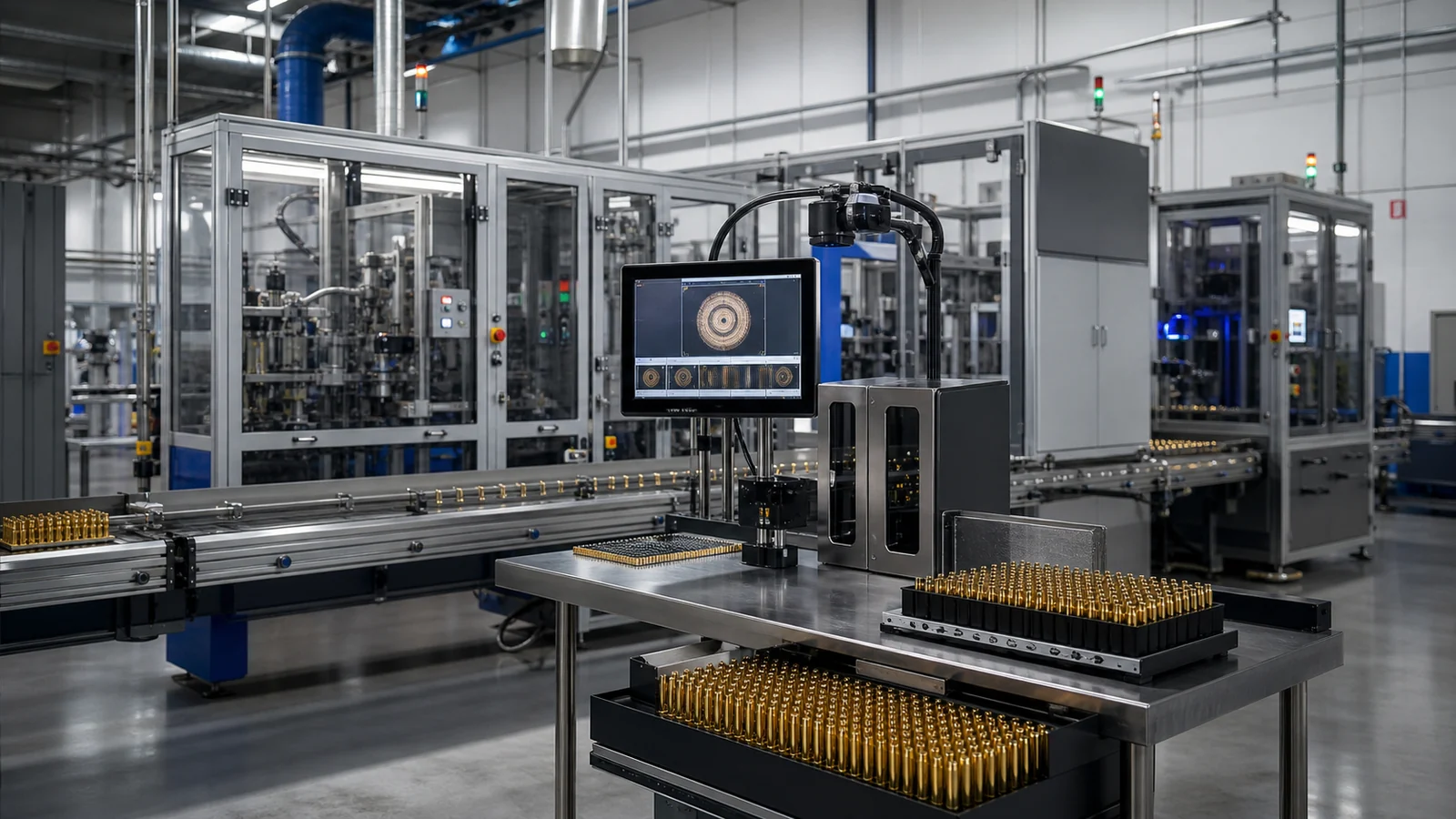
Editorial illustration created for Gun Place. Not documentary photography.
First Breach says newly installed loading and inspection equipment at its Hagerstown, Maryland, plant has raised potential ammunition output by about 175%, giving the facility capacity to produce as many as 20 million rounds per month on a 24-hour schedule. The equipment is installed and operational, according to the company’s September 1, 2026 announcement.
The increase is notable for a relatively young publicly traded ammunition manufacturer, but the number requires context. “Capacity” describes what the production system may be capable of under stated conditions; it does not mean First Breach is currently producing or selling 20 million rounds every month. The company did not disclose current monthly output, booked orders tied to the expansion, utilization rates or the caliber mix expected to run through the new equipment.
That distinction makes this more than a routine equipment announcement. First Breach ammunition capacity is expanding during a period when the company is attempting to scale from a small revenue base, improve manufacturing efficiency and support a broader catalog of components and finished cartridges. Its latest federal filing shows both the opportunity and the execution risk behind the headline figure.
First Breach ammunition capacity: what is confirmed
In a company release distributed through ACCESS Newswire, First Breach said new ammunition-loading and inspection equipment is operational at its Maryland facility. Management said the additions increase capacity approximately 175% and could support output of up to 20 million rounds per month as the plant transitions to continuous operations.
The company describes its Hagerstown operation as vertically integrated. Its investor materials say the plant produces brass cups, cartridge cases, projectiles, lead cores, lead wire and completed ammunition. First Breach lists 9mm, .223 Remington and 5.56 NATO among its ammunition and component offerings.
Automated inspection is as consequential as loading speed. Higher throughput is only commercially useful when dimensional, cosmetic and functional checks keep pace with production. The announcement does not identify the equipment supplier, inspection rejection rates or the amount invested, so readers should avoid assuming specific quality improvements beyond the company’s statement that the equipment is operating.
Capacity is not the same as production
A maximum monthly figure depends on uptime, staffing, raw-material availability, maintenance, product changeovers, quality-control yields and customer orders. A plant can possess theoretical capacity without running every line at full speed. First Breach’s reference to a transition toward a 24-hour schedule also indicates that reaching the stated ceiling depends on operating conditions, not only installed machinery.
The company’s quarterly report reinforces that caution. In its Form 10-Q filed August 28, First Breach reported $361,357 in net revenue for the first six months of 2026, up from $110,905 a year earlier. Cost of revenue was $1.24 million, producing a negative gross margin of $874,359. Management attributed part of the cost pressure to higher fixed manufacturing costs and lower production volumes.
The same filing says First Breach spent about $1.68 million on capital expenditures during the first half of 2026, compared with roughly $88,000 in the year-earlier period. It also disclosed $4.92 million in cash, negative working capital of $8.23 million and a $28.52 million six-month net loss, much of which reflected non-cash stock compensation. Management stated that recurring losses and limited revenue created substantial doubt about the company’s ability to continue as a going concern over the following 12 months.
Those figures do not negate the equipment announcement. They explain why utilization, orders and cash conversion matter. Installed capacity can create operating leverage if demand fills it; underused equipment can instead leave fixed costs spread across too few units. For a small manufacturer, the next meaningful evidence will be sustained production and sales—not the nameplate maximum alone.
What the expansion could mean for the ammunition market
If First Breach can ramp reliably, the additional line could add domestic supply in high-volume centerfire categories and provide more component capacity to other ammunition businesses. That potential is relevant to retailers because ammunition availability is shaped not only by the largest brands, but also by specialized manufacturers supplying cases, projectiles and private-label or contract production.
The announcement does not establish that retail prices will fall. Raw-material costs, freight, financing, dealer inventory and demand all affect shelf pricing. It also does not identify a major new customer or government contract. Gun Place will treat the 20-million-round figure as stated capacity until shipment volumes or financial results demonstrate sustained utilization.
Recent Gun Place News coverage provides useful industry context. Winchester’s second-quarter ammunition results showed improved sales at a mature producer, while Federal’s Nordic police contract illustrated how a disclosed order can support a capacity story with a defined customer and volume. First Breach has not announced an equivalent order in connection with today’s expansion.
What to watch next
Three indicators will show whether the new First Breach ammunition capacity becomes meaningful output: reported revenue growth, better absorption of factory overhead and evidence that the company can fund working capital as production rises. Customer concentration also deserves attention. First Breach told investors that three customers represented 43%, 24% and 12% of first-half sales, making order timing potentially significant.
For consumers, no immediate action is required. The company’s announcement concerns manufacturing capability, not a recall, product warning or change in ammunition specifications. Buyers should continue matching ammunition to the firearm manufacturer’s stated caliber and pressure requirements and inspect every package for the correct markings.
Gun Place will follow subsequent production disclosures through its Ammunition & Components coverage and publish material updates through the Gun Place Newsroom. This article is informational and is not investment advice.
Sources
- First Breach: manufacturing-capacity announcement distributed by ACCESS Newswire, September 1, 2026.
- First Breach Form 10-Q for the quarter ended June 30, 2026, filed August 28, 2026.
- First Breach investor overview and manufacturing description, accessed September 1, 2026.
Gun Place newsroom policies: Editorial Policy · Corrections · Ownership & Funding · Editorial contact.
