

Winchester Ammunition Sales Rise 11.8% as Demand Improves
Published: August 12, 2026 at 8:07 AM MST
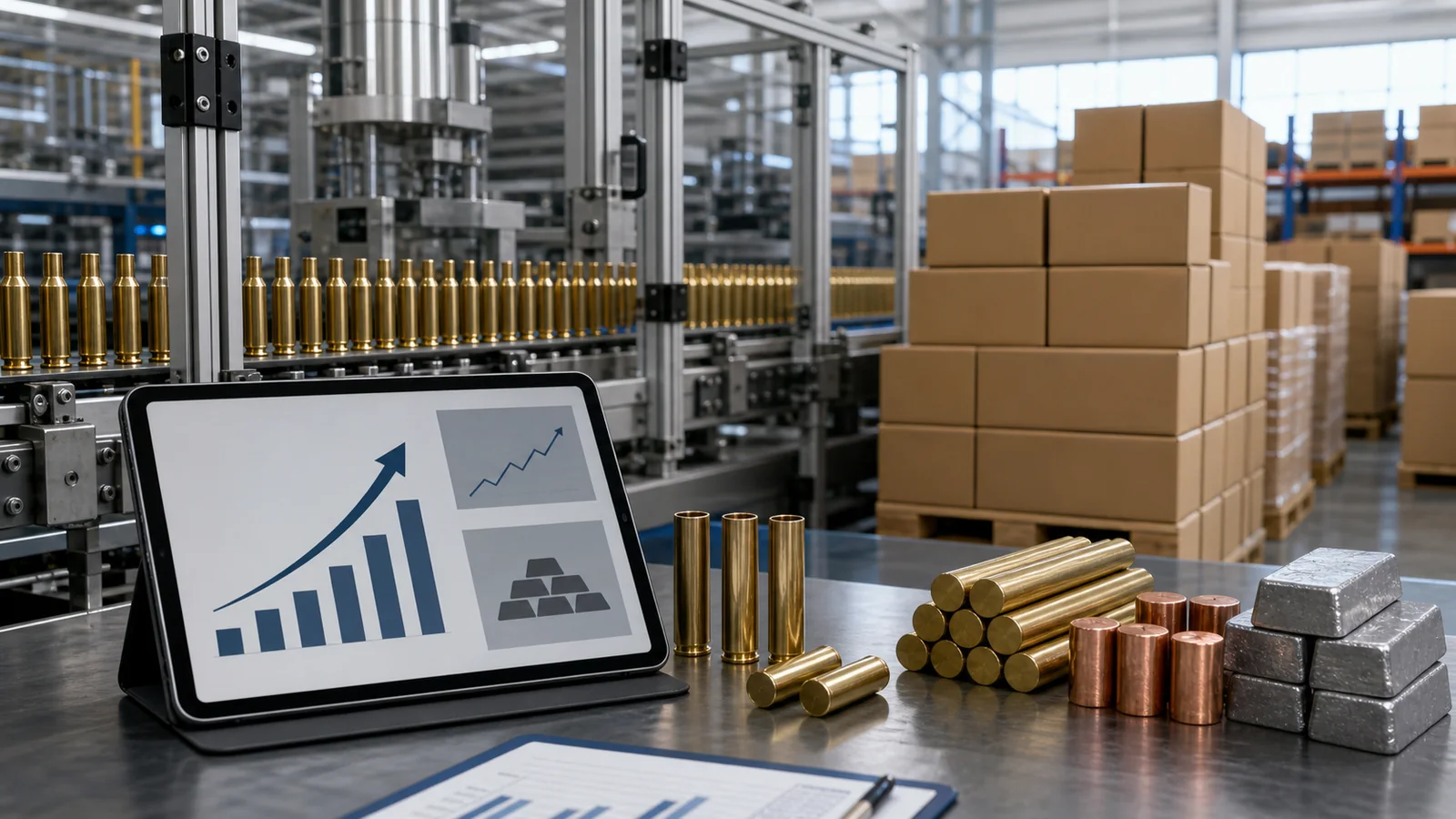
Editorial illustration created for Gun Place. Not documentary photography.
August 12, 2026: Winchester’s ammunition business reported stronger second-quarter commercial demand and higher sales, but its first-half results show that rising metal and operating costs continue to limit how much of that growth reaches the bottom line.
Winchester Q2 2026 sales reached $500.3 million for the quarter ended June 30, up 11.8% from $447.6 million a year earlier. Parent company Olin attributed the increase primarily to higher commercial ammunition sales and higher military project revenue.
The report is an important non-regulatory signal for the ammunition market. It indicates improving demand and successful pricing actions, while also showing that higher commodity-metal and operating costs remain a meaningful constraint for manufacturers, retailers and ultimately consumers.
Winchester Q2 2026 sales improved from both comparison periods
Winchester segment earnings increased to $28.1 million from $25 million in Q2 2025, a 12.4% gain. Olin said higher commercial ammunition pricing and volume, together with more military project revenue, drove the improvement. Those benefits were partially offset by higher raw-material costs—primarily commodity metals—and higher operating expenses.
The sequential recovery was stronger. Winchester reported $470.5 million in sales and $15.2 million in segment earnings during Q1 2026. Compared with those figures, second-quarter sales rose approximately 6.3%, while segment earnings increased about 84.9%. These percentages are Gun Place calculations based on Olin’s published quarterly results.
Seasonality played a role. Olin had forecast stronger commercial and military demand for Q2 and now expects seasonally improving commercial demand to support additional sequential earnings growth in the third quarter. That is management guidance, not a confirmed future result.
First-half ammunition revenue rose faster than earnings
Combining Olin’s Q1 and Q2 disclosures provides a clearer view than either quarter alone. Winchester generated approximately $970.8 million in first-half 2026 sales, compared with $835.6 million during the same period in 2025. That is an increase of about 16.2%.
Segment earnings moved the other way. Winchester generated approximately $43.3 million in first-half 2026 segment earnings, down about 9.4% from $47.8 million in the first half of 2025. Again, these are Gun Place calculations using the quarterly figures Olin reported.
The difference suggests that sales growth alone does not tell the full ammunition-market story. Commercial pricing and volume improved, but metal and other operating costs consumed more of the revenue. The Q2 segment-earnings margin was about 5.6%, nearly unchanged from Q2 2025, while the first-quarter margin had been only about 3.2%.
Metal costs remain central to ammunition pricing
Ammunition manufacturing is directly exposed to brass, copper, lead and other material inputs. Olin did not disclose a caliber-by-caliber cost breakdown, and its report does not establish how much of its pricing action will appear in any particular retail product. It does, however, explicitly identify commodity-metal inflation as a pressure on Winchester’s results.
That matters for buyers comparing current ammunition availability and pricing. Retail prices are influenced by many layers: manufacturer input costs, product mix, distributor inventories, freight, retailer inventory positions and competitive promotions. A manufacturer’s higher revenue does not automatically mean an equivalent increase in unit demand or a uniform price change across calibers.
The current evidence points to a mixed market rather than a broad shortage. A recent RetailBI Q2 shooting-sports report, based on automated data from more than 2,000 retailers, described higher prices, leaner dealer inventory and uneven demand across categories. Winchester’s results add manufacturer-level evidence that commercial ammunition demand improved even as input costs remained elevated.
Expanded manufacturing assets add another variable
Winchester’s current footprint includes the former AMMO, Inc. small-caliber ammunition manufacturing assets acquired by Olin in April 2025. According to an Olin SEC filing, the transaction included brass-shell-case capabilities and a 185,000-square-foot facility in Manitowoc, Wisconsin.
Olin recorded $55.8 million as consideration for the acquired assets. The former owner’s annual filing says the transaction had a $75 million gross purchase price before working-capital, real-estate and other adjustments, with approximately $42.9 million in net proceeds after adjustments.
The quarterly disclosures do not isolate how much revenue or output came from that facility, so it would be speculative to credit the Q2 increase to the acquisition. The added brass and small-caliber capacity is nevertheless relevant when evaluating Winchester’s ability to serve commercial, law-enforcement and military markets over time.
What the results mean for ammunition buyers and retailers
For retailers, the report supports close attention to sell-through by caliber rather than treating all ammunition as a single market. Improved manufacturer demand can coexist with slower-moving dealer inventory, especially when consumers respond differently to premium hunting loads, defensive ammunition and high-volume range cartridges.
For consumers, the most defensible takeaway is modest: commercial demand has improved, but the cost environment remains firm. Olin’s pricing actions were intended to offset inflation rather than signal a broad retail increase of a specific size. Buyers should compare current per-round prices and availability instead of assuming every Winchester product will follow the segment average.
This update also adds new evidence to Gun Place’s earlier overview of the 2026 ammunition market. The latest quarter confirms stronger commercial activity, while the half-year calculations show why revenue growth has not translated into comparable earnings growth.
What to watch next
The next earnings report should clarify whether seasonally stronger commercial demand continues, whether pricing keeps pace with metal costs and whether Winchester can sustain the Q2 margin improvement. Changes in distributor and retailer inventory will also matter because factory shipments can lead or lag purchases by end users.
Gun Place will continue following manufacturer results, component costs and retail conditions in its Ammunition & Components coverage.
This article is for general informational purposes and is not investment advice. Corporate segment results include management estimates and may not correspond directly to retail unit sales or prices.
Sources
- Olin Corporation: Second Quarter 2026 Results
- Olin Corporation: First Quarter 2026 Earnings Release filed with the SEC
- Olin Corporation Q1 2026 Form 10-Q
- Outdoor Holding Company 2026 Form 10-K
- RetailBI Q2 2026 Shooting Sports Market Report summary
Gun Place newsroom policies: Editorial Policy · Corrections · Ownership & Funding · Editorial contact.
