

Tupac Trial Tests a Gun Case Without the Murder Weapon
Published: August 20, 2026 at 2:19 PM MST
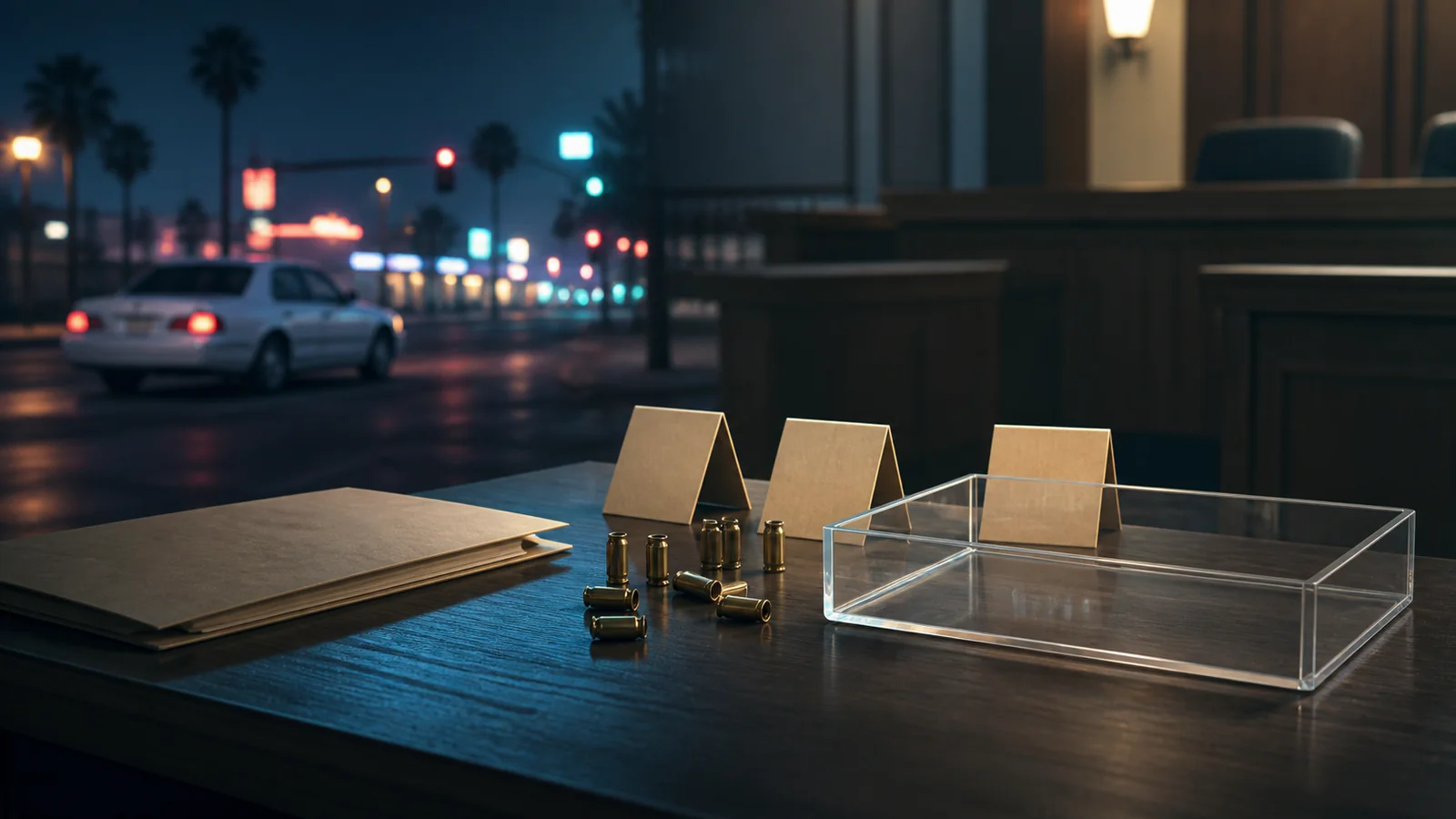
Editorial illustration created for Gun Place. Not documentary photography.
Updated August 20, 2026: The Las Vegas murder trial of Duane “Keffe D” Davis is testing how prosecutors can connect a defendant to a decades-old shooting when authorities never recovered the alleged murder weapon or the vehicle from which the shots were fired.
The Tupac Shakur trial began this week in Clark County District Court, nearly 30 years after Shakur was shot near the Las Vegas Strip on September 7, 1996. Davis is charged with murder with a deadly weapon with the intent to promote, further or assist a criminal gang. He has pleaded not guilty.
Prosecutors do not allege that Davis pulled the trigger. Their theory is that he organized a retaliatory attack and supplied a gun to men riding in the back of a white Cadillac. The defense calls that account unreliable and argues that the state’s case leans heavily on statements Davis made years later. The jury must therefore separate two questions: what the surviving firearm evidence establishes about the shooting, and whether other evidence proves Davis was criminally responsible for it.
Why the missing murder weapon matters
A recovered firearm can give investigators several avenues of comparison. Examiners may evaluate whether it functions, compare test-fired cartridge cases and projectiles with crime-scene evidence, document identifying characteristics and establish a chain of custody. None of that automatically identifies the person who fired it, but the firearm can connect otherwise separate pieces of a case.
Here, authorities say neither the gun nor the white Cadillac was recovered, according to the Associated Press trial overview. That prevents a direct comparison between a seized weapon and the physical evidence collected in 1996.
It does not mean there is no firearm evidence. Jurors have seen shell casings collected after the shooting, and testimony has addressed the projectiles and Shakur’s wounds. That evidence can help establish how the attack occurred. Its ability to identify who supplied or used the gun is a separate and more contested issue.
What prosecutors allege about the gun
Prosecutors say the shooting followed a fight at the MGM Grand involving Shakur’s entourage and Davis’ nephew, Orlando “Baby Lane” Anderson. They allege Davis then helped plan retaliation, obtained a firearm and rode in the Cadillac that later pulled alongside the BMW occupied by Shakur and Marion “Suge” Knight.
During opening statements, the prosecution told jurors that Davis did not fire the fatal shots but planned the attack. The state also played an interview in which Davis described handing a gun to the men in the Cadillac’s back seat, according to Associated Press coverage of the trial.
Those are allegations, not established facts. Davis’ attorney told jurors that the prosecution’s narrative is fiction and questioned whether accounts given in interviews and a memoir should be treated as reliable. Davis remains presumed innocent unless the state proves the charge beyond a reasonable doubt.
What the physical evidence can—and cannot—show
The early trial testimony has focused on the immediate aftermath of the shooting and its medical consequences. A responding officer displayed cartridge cases recovered from the scene. A forensic pathologist described the paths of bullets through Shakur’s body, including injuries to a lung and other organs, as reported in the AP’s account of the second day of testimony.
That evidence is important because it documents a fatal shooting and preserves physical facts independent of anyone’s memory. But without the firearm, it cannot be matched to a particular recovered gun. Nor does a cartridge case, by itself, establish who acquired, transferred or fired the weapon.
This distinction is often lost in public discussion of high-profile cases. Ballistic and medical evidence may strongly establish the mechanics of a shooting while leaving questions of identity and legal responsibility to witness testimony, records, admissions and circumstantial evidence.
The case turns on more than who pulled the trigger
The state’s theory does not require jurors to find that Davis was the shooter. Prosecutors are attempting to prove that he intentionally enabled and directed the attack. That makes his alleged role in obtaining and passing the gun central even though the weapon itself is absent.
The prosecution is relying in part on Davis’ recorded interviews and his 2019 memoir, “Compton Street Legend.” A judge ruled before trial that the book could be used as evidence. The defense unsuccessfully sought to exclude it and challenged the circumstances surrounding earlier police interviews, according to FOX5 Las Vegas.
For jurors, the central problem is not merely whether Davis described possessing or passing a gun. They must decide what portions of his various accounts are credible, whether those statements are corroborated and whether the total evidence satisfies every element of the charged offense.
Why a 30-year-old firearm case is difficult
Time has narrowed the available evidence. The three other men whom authorities say were in the Cadillac have died. Memories can fade, witnesses can become unavailable and physical items can be lost. The absence of the car and gun also denies both sides opportunities for additional forensic testing.
At the same time, old cases can change when new statements, records or technology give investigators a reason to reexamine preserved evidence. In this case, prosecutors say Davis’ public interviews and memoir helped revive an investigation that had gone cold. The defense argues that those same statements are inconsistent, exaggerated or untrustworthy.
The Tupac Shakur trial therefore offers a useful lesson for readers following firearms-related legal cases: a missing gun does not automatically end a prosecution, but it changes what the remaining evidence must accomplish. Physical firearm evidence can explain the shooting. Linking a defendant to the weapon and the criminal plan may depend on an entirely different body of proof.
What to watch as the Tupac Shakur trial continues
Jurors are expected to hear from dozens of witnesses during a trial projected to last several weeks. The most consequential questions will be whether later testimony corroborates Davis’ accounts, how the defense challenges the reliability of those accounts and whether investigators can connect the surviving physical evidence to the prosecution’s theory without presenting the firearm itself.
Gun Place will follow confirmed courtroom developments through credible reporting and official records when available. Readers can find continuing coverage in our Firearms News archive.
This article is for general informational purposes and is not legal advice. Davis has pleaded not guilty and is presumed innocent unless proven guilty.
Sources
- Associated Press: What to know about the Tupac Shakur murder trial
- Associated Press: Opening statements and early testimony
- Associated Press: Firearm and medical evidence presented to jurors
- FOX5 Las Vegas: Pretrial evidentiary rulings
Gun Place newsroom policies: Editorial Policy · Corrections · Ownership & Funding · Editorial contact.
