

Supreme Court Sets December 2 Arguments in AR-15 Ban Cases
Published: September 12, 2026 at 8:06 AM MST
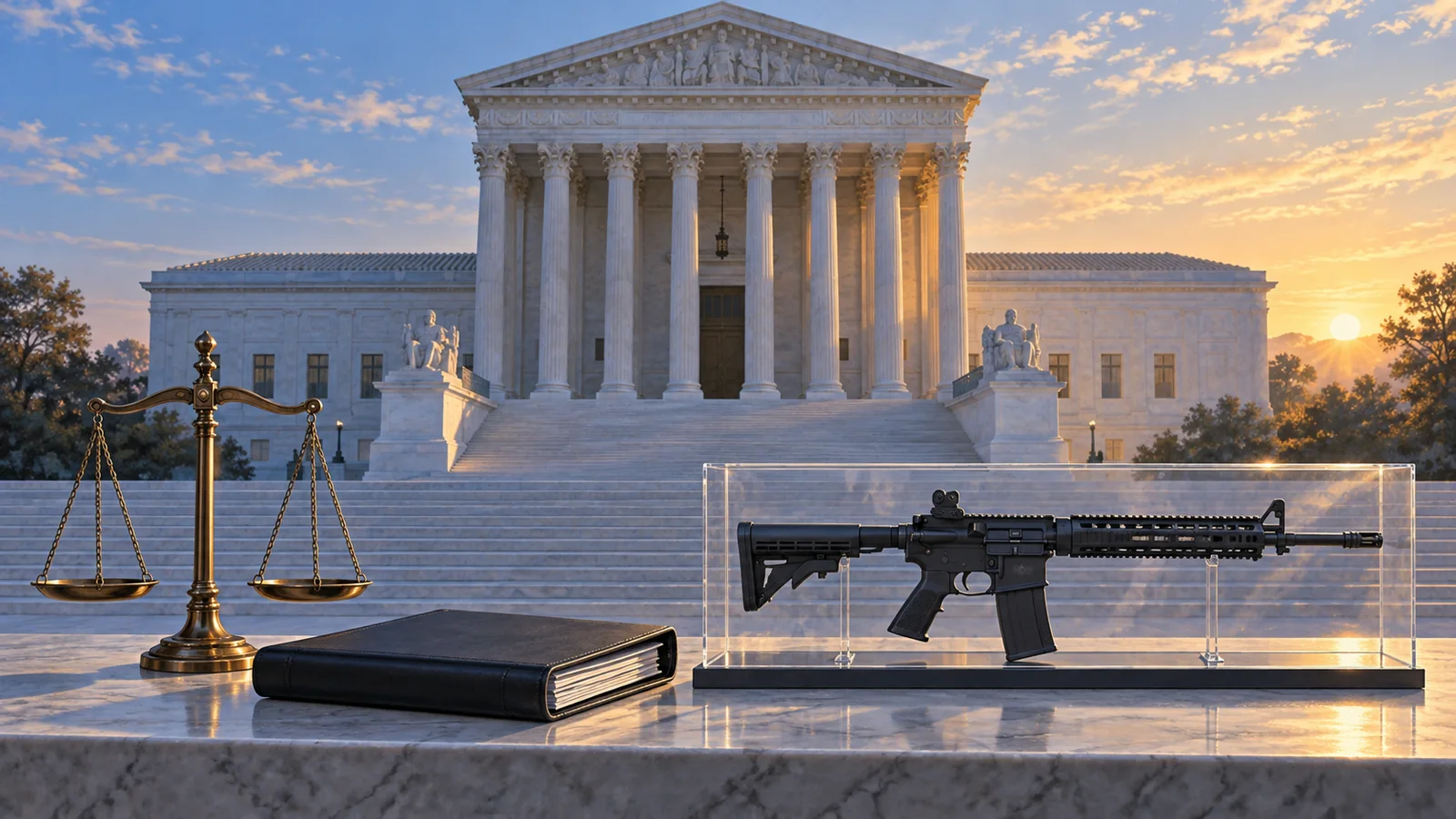
Editorial illustration created for Gun Place. Not documentary photography.
WASHINGTON, September 12, 2026 — The U.S. Supreme Court has scheduled oral argument for December 2 in two consolidated cases that ask whether categorical bans on possession of AR-15-style semiautomatic rifles violate the Second Amendment. The cases, Viramontes v. Cook County and Grant v. Higgins, could produce the Court’s most consequential ruling yet on state and local restrictions covering commonly owned semiautomatic rifles.
Since Gun Place’s August 2 overview of the cases, three material developments have occurred: the Court fixed the December 2 argument date, the challengers filed their opening merits brief, and the United States filed in support of the challengers. None changes firearm law today. The challenged restrictions remain in effect, and the Court has not ruled on their constitutionality.
Supreme Court AR-15 ban cases set for December 2
The Court’s December argument calendar places the consolidated cases on Wednesday, December 2, with one hour allotted for argument. The Court consolidated the cases for briefing and argument in June, so new filings for both disputes appear on the docket for case No. 25-238.
Viramontes challenges Cook County’s ordinance prohibiting possession of firearms it defines as “assault weapons,” including the AR-15. In June 2025, the Seventh Circuit affirmed judgment for the county, explaining that its earlier Bevis decision controlled the challenge. Grant concerns Connecticut’s statutory restrictions, which prohibit possession of defined assault weapons subject to grandfathering and other exceptions. The Second Circuit upheld the denial of a preliminary injunction.
The cases arrive from different courts and at different procedural stages. That matters because the Supreme Court may address the constitutional test broadly while leaving some case-specific issues for lower courts to resolve afterward.
The United States supports the challengers
In a September 4 friend-of-the-court brief, the United States urged the Supreme Court to rule for the challengers. The federal government is not a party to either case. Its brief argues that AR-15 rifles are protected “arms,” that the Second Amendment does not permit categorical bans on arms commonly used by law-abiding citizens for lawful purposes, and that the lower courts relied on tests inconsistent with Supreme Court precedent.
Those are advocacy positions, not judicial findings. Cook County and Connecticut will present their own merits arguments, and their briefs are due October 21 according to the Court’s docket. They have previously defended the laws by emphasizing the rifles’ characteristics, their asserted relationship to military weapons, and the governments’ public-safety interests.
On September 9, the solicitor general also asked to participate in oral argument and divide the challengers’ allotted time. The justices must decide whether to grant that request. Solicitor-general participation can be influential, but it does not indicate how the Court will rule.
What the challengers are asking the Court to decide
The challengers’ joint opening brief asks the Court to apply the “common use” principle associated with District of Columbia v. Heller and later Second Amendment decisions. They contend that millions of Americans lawfully possess AR-15-style rifles for purposes including target shooting, hunting, competition and self-defense, making categorical possession bans unconstitutional.
The governments have not yet filed their Supreme Court merits briefs, so a complete comparison of the parties’ current positions is not possible. Their responses may contest the challengers’ characterization of common use, argue that the regulated firearms fall outside constitutional protection, or defend the restrictions through the historical-tradition analysis required by New York State Rifle & Pistol Association v. Bruen. Gun Place will review those filings when they appear.
Why the ruling could reach beyond Illinois and Connecticut
A merits decision could affect challenges to similar laws in other jurisdictions, but the practical reach will depend on the Court’s reasoning. A narrow opinion might resolve only particular features of the two laws or the records developed below. A broader opinion could establish a controlling test for evaluating bans on categories of semiautomatic rifles nationwide.
The dispute also gives the Court an opportunity to address disagreement among lower courts over how to identify protected arms. The federal brief criticizes tests based on whether a firearm is considered “military-style” or “especially dangerous,” while the challengers argue that widespread lawful ownership should be central. Respondents are expected to defend the lower-court approaches and the authority of governments to regulate weapons they consider unusually hazardous.
This term’s cases are separate from the Third Circuit standing decision discussed in Gun Place’s recent New Jersey gun-industry law report. Readers can follow related court and policy coverage through the Legal & Regulatory archive.
What firearm owners and retailers should do now
For owners, dealers and manufacturers, the immediate takeaway is restraint: the argument date and federal brief do not suspend or invalidate existing restrictions. Businesses should continue following the laws applicable to the buyer, seller and destination jurisdiction. Owners should consult current official guidance in their jurisdiction rather than treating predictions about the cases as law.
The next major filing deadline is October 21 for the respondents’ briefs. Reply briefing will follow, then the Court will hear argument on December 2. A decision would ordinarily be expected later in the Court’s term, but the Court has announced no decision date.
Gun Place will continue distinguishing filed arguments from holdings and will update readers when the respondents submit their briefs or the Court issues a material order. Our sourcing and corrections standards are available in the Gun Place Newsroom.
This article is for general informational purposes and is not legal advice. Firearm laws vary by jurisdiction and can change; consult qualified counsel or the relevant government authority about a specific situation.
Sources
- U.S. Supreme Court docket, Viramontes v. Cook County, No. 25-238
- U.S. Supreme Court, December 2026 argument calendar
- Brief for the United States as amicus curiae
- Joint merits brief for the petitioners
- Seventh Circuit disposition in Viramontes
- Connecticut General Statutes, Chapter 943
Gun Place newsroom policies: Editorial Policy · Corrections · Ownership & Funding · Editorial contact.
