

Supreme Court AR-15 Case Moves Toward Briefing: What Gun Owners Should Watch
Published: August 2, 2026 at 2:18 PM MSTUpdated: August 2, 2026 at 4:00 PM MST
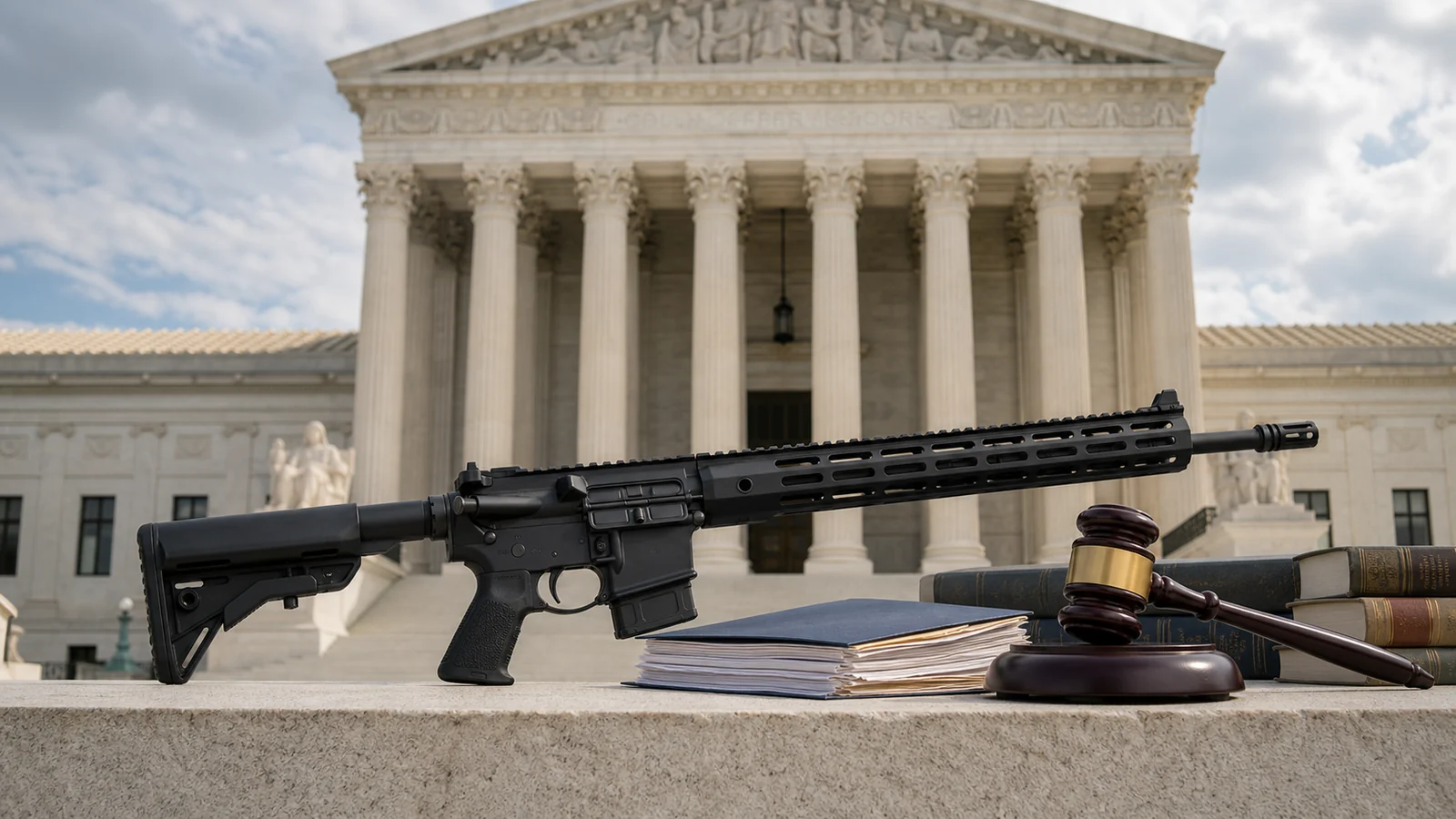
Editorial illustration created for Gun Place. Not documentary photography.
Updated August 2, 2026: The U.S. Supreme Court is preparing to hear a pair of consolidated cases that could determine whether the Second Amendment protects possession of AR-15-platform and similar semiautomatic rifles. The outcome could reshape firearm laws well beyond Illinois and Connecticut.
The Court granted review on June 30 in Viramontes v. County of Cook and Grant v. Higgins. The cases challenge restrictions imposed by Cook County, Illinois, and Connecticut. They have been consolidated for briefing and oral argument, with future filings tracked primarily under Supreme Court docket No. 25-238.
The central question is direct: Do the Second and Fourteenth Amendments guarantee a right to possess AR-15-platform and similar semiautomatic rifles?
That makes this one of the most consequential firearms cases the Supreme Court has accepted in years. It also arrives while federal appeals courts are reaching sharply different conclusions about similar laws.
Readers tracking state-level changes can also review Gun Place’s guide to Colorado’s 2026 ammunition laws, which explains how a separate set of purchasing, display, and delivery requirements affects buyers and retailers.
What the Supreme Court has agreed to decide
The Court’s decision to hear a case is not a ruling on the merits. The Illinois and Connecticut restrictions remain in effect unless another court order changes their status. Gun owners and retailers should continue following all current federal, state, and local requirements while the litigation proceeds.
What has changed is that the justices will now address a question they previously left unresolved: whether commonly owned semiautomatic rifles fall within the Second Amendment’s protection.
Under the Supreme Court’s modern Second Amendment cases, courts generally begin by asking whether the conduct at issue is covered by the amendment’s text. If it is, the government must justify the regulation by showing that it is consistent with the nation’s historical tradition of firearm regulation.
The challengers argue that AR-15-style rifles are commonly possessed for lawful purposes and therefore cannot be prohibited. Cook County and Connecticut defend their laws by arguing, among other points, that the restricted firearms may be regulated as unusually dangerous weapons and that the laws fit within relevant historical traditions.
Why the timing matters
The Supreme Court’s review comes amid an increasingly visible disagreement among lower courts.
On July 9, the U.S. Court of Appeals for the Seventh Circuit upheld Illinois restrictions on specified semiautomatic firearms and magazines in a group of related cases led by Barnett v. Raoul. The majority concluded that the laws were consistent with the principles underlying the nation’s tradition of firearm regulation. A dissent argued that the AR-15 and its magazines are widely chosen by Americans and protected by the Second Amendment.
Eight days later, the U.S. Court of Appeals for the Third Circuit, sitting as a full court, struck down New Jersey’s prohibitions on covered semiautomatic rifles and magazines holding more than 10 rounds. That court expanded a lower-court ruling that had invalidated the ban only as applied to the AR-15 and concluded that the state had not adequately justified the broader restrictions under the Supreme Court’s framework.
Those decisions do not control the Supreme Court, and differences in statutory language and case records matter. But the contrasting results show why national guidance is increasingly important. Whether a particular rifle or magazine may be sold can depend heavily on the jurisdiction.
The current Supreme Court schedule
The Court has consolidated the Cook County and Connecticut cases for briefing and oral argument. According to the docket, the joint appendix and the challengers’ opening merits brief are due August 28, 2026. The government respondents’ merits briefs are due October 21, 2026.
Additional briefs from supporting organizations, legal scholars, public officials, and other interested parties are also likely. An oral-argument date has not yet been announced on the public docket.
A final decision would ordinarily be expected by the end of the Supreme Court term in which the case is argued, although the Court controls its schedule and no outcome or release date can be guaranteed.
What a broad ruling could affect
A decision for the challengers could invalidate the Cook County and Connecticut restrictions and create a rule that affects similar bans elsewhere. Depending on the breadth of the opinion, it could influence cases involving state and local definitions of “assault weapons,” feature-based restrictions, model-specific bans, and possibly related magazine limits.
A decision for the governments could give states and localities clearer authority to retain these laws. The Court could also issue a narrower ruling tied to the specific records, definitions, or historical evidence in the two cases, leaving some questions for later litigation.
The magazine issue deserves particular caution. Although magazine restrictions appear throughout the broader litigation, the question accepted by the Court focuses on AR-15-platform and similar semiautomatic rifles. The eventual opinion may discuss magazines, but readers should not assume that every magazine-capacity dispute will necessarily be resolved.
What gun owners and retailers should do now
For the moment, the practical answer is to follow existing law. The grant of Supreme Court review does not suspend a ban, reopen a restricted market, or authorize a transaction that is currently prohibited.
Retailers should continue maintaining jurisdiction-specific product restrictions and monitoring official court orders. Owners traveling or moving between states should verify the rules at both their origin and destination, including separate requirements governing transportation, possession, registration, and magazines.
Consumers should be skeptical of social-media claims that the Supreme Court has already “legalized” or “banned” a category of firearm. No merits decision has been issued. The next major public milestones are the briefing deadlines, the scheduling of oral argument, and ultimately the Court’s written opinion.
The bottom line
The Supreme Court’s decision to hear Viramontes and Grant puts the constitutional status of AR-15-style rifles squarely before the justices. With federal appeals courts now issuing conflicting rulings on similar restrictions, the case has the potential to establish a nationwide rule affecting owners, dealers, manufacturers, and state legislatures.
Nothing changes overnight. Current laws remain enforceable, and the case is still in the briefing stage. But for the firearms industry and millions of lawful rifle owners, this is the case to watch during the Court’s next term.
This article is for general informational purposes and is not legal advice. Firearm laws change frequently and may vary by state and locality. Consult current official guidance or qualified counsel for advice about a specific situation.
Sources
- U.S. Supreme Court docket, Viramontes v. County of Cook, No. 25-238
- U.S. Supreme Court docket, Grant v. Higgins, No. 25-566
- U.S. Court of Appeals for the Seventh Circuit, Barnett v. Raoul
- U.S. Court of Appeals for the Third Circuit, Association of New Jersey Rifle & Pistol Clubs v. Attorney General
- Duke Center for Firearms Law, SCOTUS Gun Watch
Gun Place newsroom policies: Editorial Policy · Corrections · Ownership & Funding · Editorial contact.
