

Cincinnati Gun Case Highlights What NIBIN Can Show
Published: September 13, 2026 at 8:05 AM MST
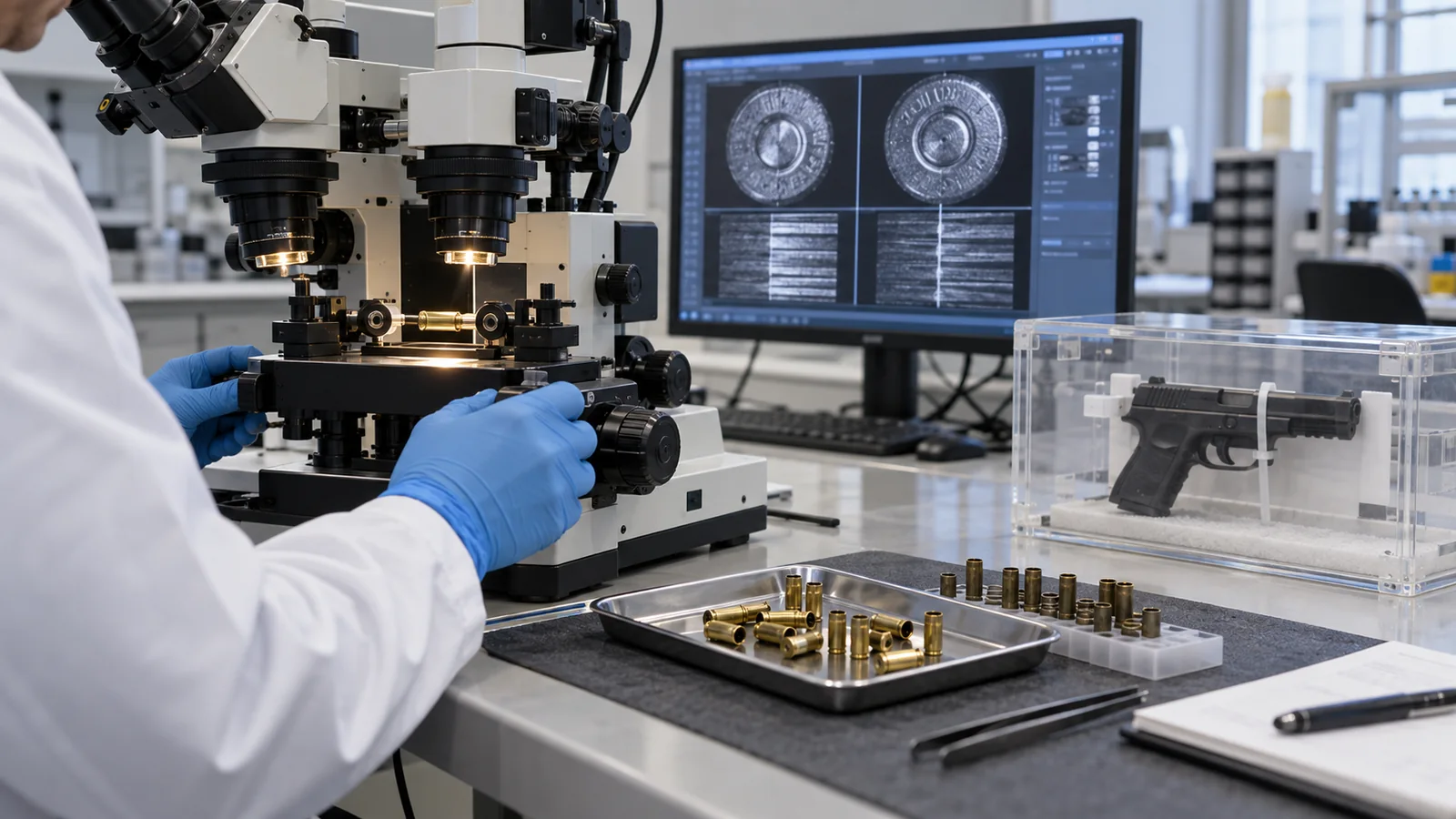
Editorial illustration created for Gun Place. Not documentary photography.
CINCINNATI, Ohio — September 13, 2026. A newly filed federal firearms case offers a timely look at how ballistic intelligence can connect evidence from separate shootings—and why those investigative links should not be confused with a finding of guilt.
Federal agents arrested 27-year-old Cincinnati resident Lamont Champion on September 11. According to the U.S. Attorney’s Office for the Southern District of Ohio, a criminal complaint alleges that Champion possessed firearms connected to at least two homicides and three shootings. He is charged with possessing a firearm after a felony conviction.
The case is at an early stage. A complaint contains allegations, Champion is presumed innocent unless proven guilty, and the government must establish its case in court. The details released so far nevertheless provide a useful example of how the National Integrated Ballistic Information Network, or NIBIN, is used to generate leads across incidents.
What the Cincinnati NIBIN case alleges
Prosecutors say officers recovered one firearm from Champion in June 2026. Ballistic results allegedly matched cartridge cases collected after a February double homicide at the Villages of Roll Hill in Cincinnati. The government has not alleged in its release that this result, standing alone, establishes who fired the gun in February.
Agents recovered a second firearm during a September 11 search. The complaint alleges that Champion used that handgun in a July shooting on East Clifton Avenue and an August shooting near the Enclave Event Center. DOJ says NIBIN analysis indicated that the same firearm was used in both incidents.
The federal charge identified in the announcement is felon in possession of a firearm, which carries a statutory maximum sentence of 15 years. A maximum is not a prediction of the outcome or sentence. Charging decisions, evidence challenges, plea negotiations, a possible indictment and any trial remain ahead.
The new allegations follow other recent examples of multiagency crime-gun work, including the D.C. task force’s report of 2,000 firearm recoveries. Each investigation has its own facts, but both show how federal and local agencies increasingly combine recovered-firearm data with other evidence.
How NIBIN ballistics creates investigative leads
NIBIN is operated by the Bureau of Alcohol, Tobacco, Firearms and Explosives. The system captures high-resolution images of markings on fired cartridge cases and compares those images with other ballistic evidence in the network. Because parts of a firearm can leave characteristic marks on a cartridge case, a comparison may identify evidence that appears to have been fired by the same gun.
ATF’s June 2026 NIBIN fact sheet is careful about terminology. Automated comparison produces a list of potentially similar results. A trained technician reviews those results and may identify a “NIBIN lead,” which ATF defines as an unconfirmed potential association based on digital images.
If confirmation is needed for court or another purpose, a firearms examiner studies the physical evidence under a microscope. ATF calls the examiner-confirmed match a “NIBIN hit.” That two-step process matters: the network is designed to prioritize possible connections quickly, while forensic confirmation requires a separate examination of the actual evidence.
ATF reports that NIBIN held more than 7.7 million pieces of ballistic evidence as of its latest fact-sheet update. During fiscal year 2025, 418 NIBIN locations acquired 623,142 pieces of evidence and generated 193,269 leads. Those figures demonstrate the system’s scale, but they do not tell readers how many leads resulted in arrests, charges or convictions.
What ballistic intelligence does not prove
A link between cartridge cases can help investigators determine that the same firearm may have been present at multiple scenes. It does not, by itself, establish who possessed or fired the gun during each incident. Nor does it establish motive, knowledge, lawful ownership history or criminal guilt.
Investigators still must evaluate where and when evidence was recovered, maintain its chain of custody, test witness accounts and digital records, and connect a person to the conduct alleged. Defense counsel may also challenge the collection, interpretation or admissibility of evidence. The Cincinnati complaint reportedly cites additional evidence, but the government’s assertions have not yet been tested at trial.
ATF also says NIBIN is used only in criminal investigations and does not store ballistic information collected when a firearm is manufactured, imported or sold. It is different from eTrace, which law enforcement uses to request a trace of a recovered firearm through commercial records.
Why the case matters to retailers and the public
For the public, the practical value of ballistic intelligence is speed. A potential association can alert investigators that incidents previously treated as unrelated may involve the same firearm. That can help agencies coordinate across neighborhoods or jurisdictions while other evidence is developed.
For federally licensed firearms retailers, NIBIN does not replace the established recordkeeping and tracing system. Licensees maintain acquisition-and-disposition records and respond to authorized trace requests; forensic laboratories handle ballistic-evidence comparisons. Nothing in DOJ’s release identifies a retailer as a source of wrongdoing in this case.
Retailers can still support public safety by maintaining accurate records, securing inventory and promptly reporting thefts or losses as required. Readers looking for broader coverage of responsible practices can follow Gun Place News in the Safety & Compliance archive.
What happens next
Champion made an initial federal court appearance on September 11. The prosecution is being handled by the U.S. Attorney’s Office for the Southern District of Ohio with participation from ATF, Cincinnati police and the Ohio Attorney General’s Office. Court filings—not press-release summaries—will provide the authoritative record as the case proceeds.
The central takeaway is narrow but important: NIBIN can surface possible links among shootings, and a firearms examiner can later evaluate physical evidence for confirmation. Neither step eliminates the need for a complete investigation or the government’s burden of proof.
This article is for general information and is not legal advice. Gun Place follows its published editorial policy when reporting allegations and corrections.
Sources
- U.S. Attorney’s Office, Southern District of Ohio: September 11, 2026 press release
- ATF: National Integrated Ballistic Information Network fact sheet, updated June 10, 2026
Gun Place newsroom policies: Editorial Policy · Corrections · Ownership & Funding · Editorial contact.
