

Ruger Q2 2026 Sales Rise 19% as Products Outpace Market
Published: August 11, 2026 at 12:02 PM MST
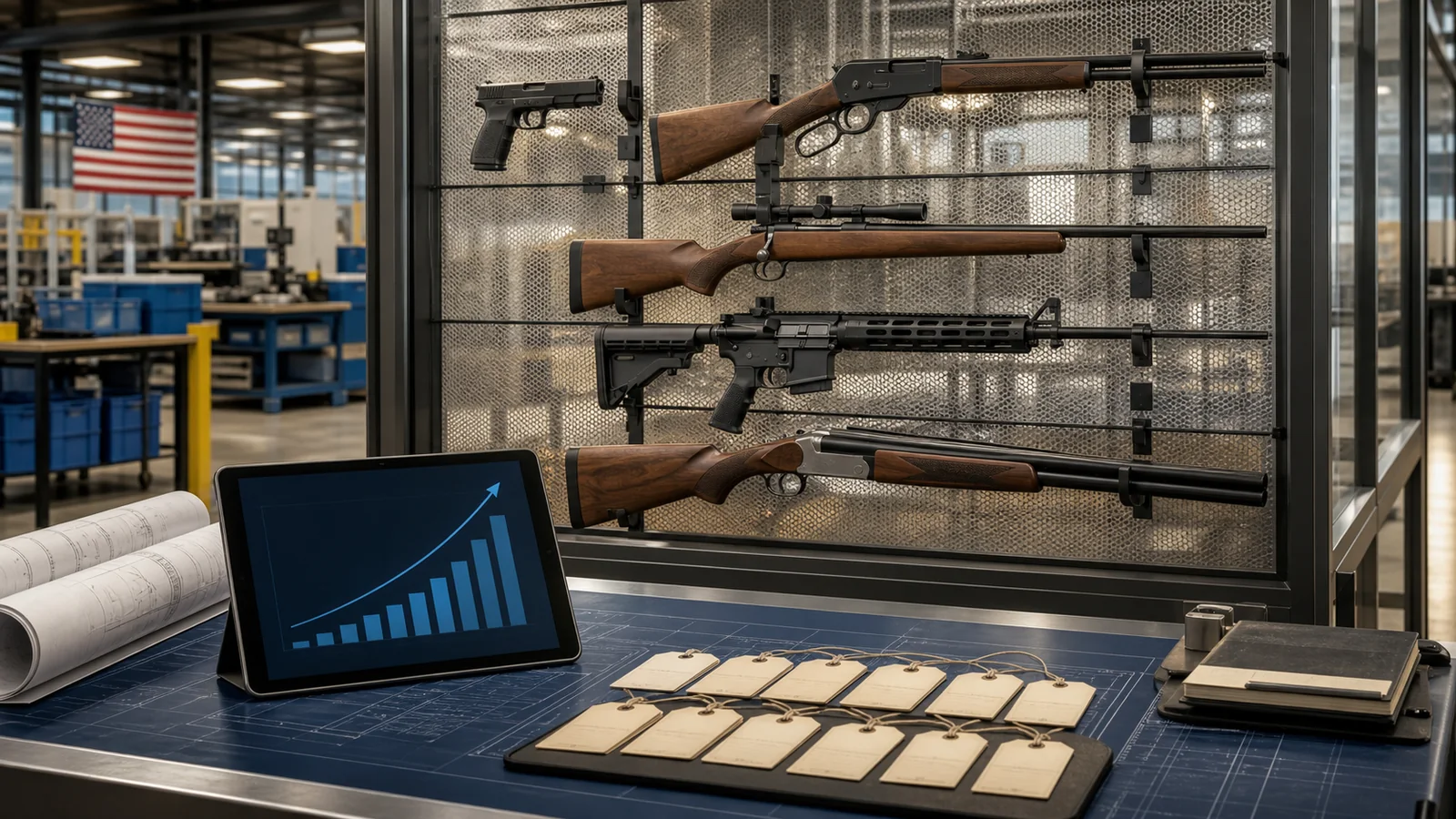
Editorial illustration created for Gun Place. Not documentary photography.
August 11, 2026: Sturm, Ruger & Company reported a sharp second-quarter improvement, with sales rising faster than the broader firearms market and stronger manufacturing execution helping the company recover from a difficult comparison period.
Ruger Q2 2026 sales reached $158.1 million for the quarter ended June 27, up 19% from $132.5 million a year earlier. The company also reported distributor-to-retailer sell-through growth of 19%, compared with a 5% increase in adjusted National Instant Criminal Background Check System activity during the same period.
The results matter beyond one manufacturer. They offer a useful view of a 2026 market in which overall unit demand remains uneven, but higher average prices, new-product launches and careful inventory management can still produce growth.
Ruger Q2 2026 sales improved across several measures
Ruger reported diluted earnings of $0.43 per share, compared with a GAAP loss of $1.05 per share in the second quarter of 2025. Adjusted earnings were $0.52 per share, up from $0.41. The company’s average selling price increased 10% to $384, while adjusted gross margin improved by four percentage points.
The year-over-year earnings comparison deserves context. Ruger’s 2025 quarter included inventory and related asset write-offs, product rationalization and organizational realignment. The 2026 quarter also included approximately $1.2 million of legal, professional and advisory costs connected with its strategic cooperation agreement with Beretta Holding, plus expenses tied to a chief financial officer transition.
The underlying operational figures are therefore more informative than the swing from loss to profit alone. Ruger generated $17.3 million in operating cash during Q2 and $36.1 million during the first half. At June 27, it reported $117.5 million in cash and short-term investments and no debt.
New products supplied growth, but core products also strengthened
For the first half of 2026, Ruger said products introduced within the previous two years generated $80.9 million, or 29% of firearm sales. The group included the RXM pistol, Marlin 1894 lever-action rifles, Ruger American Centerfire Rifle Generation II, Glenfield rifles, Harrier rifles and the Ruger Red Label III shotgun.
That list spans most of the commercial sporting market rather than relying on one platform. Readers can see the breadth of the company’s current footprint in Gun Place’s Ruger product archive.
There is also an important detail behind the cumulative number. Ruger reported $51.6 million of new-product sales in Q1. Subtracting that from the $80.9 million first-half total suggests approximately $29.3 million of new-product sales in Q2, or about 19% of Q2 firearm sales. That is a Gun Place calculation based on Ruger’s published figures, not a standalone quarterly number reported by the company.
The calculation suggests Q2 growth was not powered only by recent launches. New products remained meaningful, but established lines appear to have contributed more heavily than in Q1, when new products represented 41% of firearm sales. That reading is consistent with management’s reference to “strong core product demand.”
Inventory data points to retail pull-through, not just factory shipments
Manufacturer revenue can rise temporarily if products accumulate at distributors. Ruger’s inventory disclosures point in the opposite direction. Compared with Q2 2025, company finished-goods inventory declined by 100,100 units, while distributor inventory declined by 45,800 units. Meanwhile, estimated distributor-to-retailer sell-through increased 19%.
Taken together, those figures indicate that dealers were moving products to consumers while the supply chain carried fewer finished units than a year earlier. Ruger said improved manufacturing execution allowed it to begin rebuilding its own finished-goods inventory during the quarter, which may improve product availability if demand holds.
The pattern broadly fits the RetailBI Q2 2026 market report. Based on automated feeds from more than 2,000 U.S. retailers, RetailBI found modestly lower new-firearm unit sales but higher revenue, continued inventory reductions and stronger performance in premium segments. Its inventory analysis drew from approximately 400 large independent point-of-sale dealers.
Higher prices are part of the story
Ruger’s 10% increase in average selling price means the 19% revenue gain should not be interpreted as a 19% increase in firearm unit volume. Product mix, pricing and volume all contributed. The company did not provide a simple consumer-sales unit total that can be directly compared with revenue growth.
For retailers, the more useful lesson is that buyers have not moved uniformly toward the least expensive option. A varied catalog and differentiated products can outperform even when overall industry unit demand is restrained. RetailBI similarly found that premium products outperformed entry-level offerings in several categories.
That does not mean every category is equally strong. RetailBI described pressure in shotguns and stronger rifle demand, while Ruger’s own new-product list spans both. Company-level performance should not be treated as a complete measure of the national market or as proof that every model is gaining share.
What retailers and consumers should watch next
Ruger expects approximately $30 million in 2026 capital spending for new-product introductions, additional capacity for high-demand lines, manufacturing upgrades and facility infrastructure. The next useful signals will be whether retail sell-through continues to exceed adjusted NICS growth, whether distributor inventories remain lean and whether higher average prices persist without weakening volume.
The company’s May agreement with Beretta Holding is another longer-term factor. Beretta may increase its Ruger ownership position to as much as 25%, subject to the agreement and applicable approvals, while Ruger remains an independent public company. The parties also said they could explore lawful commercial cooperation, but neither company has announced a specific product or manufacturing program arising from that provision.
Gun Place will continue tracking manufacturer results and broader retail indicators in its Industry & Market coverage. The Q2 figures show why those two views must be read together: national background checks provide scale, but pricing, product mix, sell-through and inventory reveal what is actually happening inside the supply chain.
This article is for general informational purposes and is not investment advice. Financial results include company estimates and non-GAAP measures; readers should consult the complete filings before drawing investment conclusions.
Sources
- Ruger: Second Quarter 2026 Results
- SEC EDGAR: Sturm, Ruger & Company filings
- RetailBI: Q2 2026 Shooting Sports Retail Sales and Inventory Report summary
- Ruger and Beretta Holding Strategic Cooperation Agreement
Gun Place newsroom policies: Editorial Policy · Corrections · Ownership & Funding · Editorial contact.
