

Firearm Excise Taxes Direct $23.1M to Arizona Wildlife
Published: September 14, 2026 at 8:06 AM MST
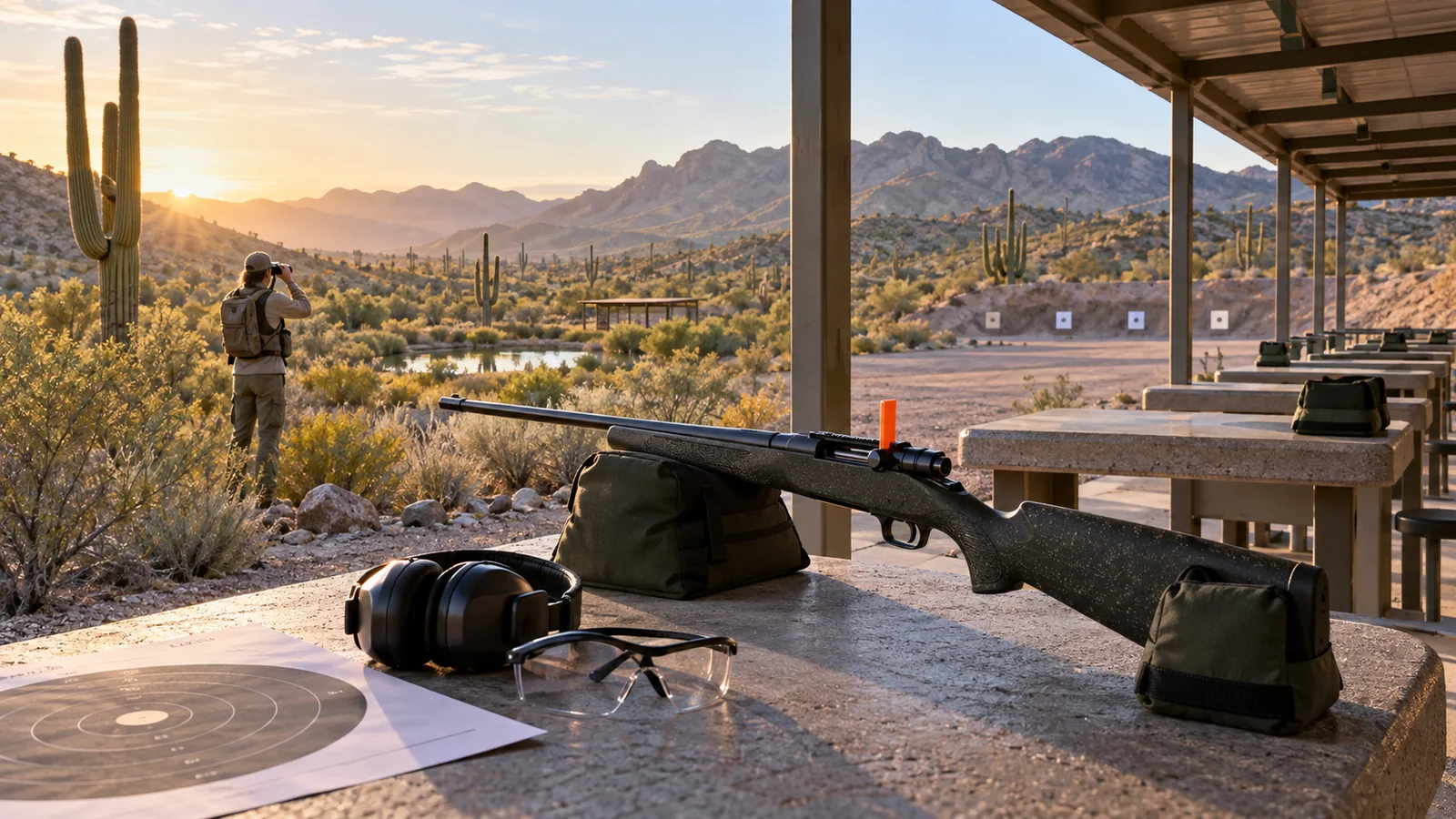
Editorial illustration created for Gun Place. Not documentary photography.
ARIZONA — September 14, 2026. A new firearms-industry spotlight on the Ben Avery Shooting Facility is drawing attention to a less visible part of every manufacturer’s balance sheet: the federal excise taxes that help finance wildlife conservation, hunter education and public shooting access.
The latest federal apportionment records show that Arizona is eligible for $23,118,473 in Wildlife Restoration funding for fiscal year 2026. That amount is part of a nationwide $842.4 million Wildlife Restoration allocation supported by manufacturers’ excise taxes on firearms, ammunition and archery equipment.
The number does not mean Arizona received a single unrestricted check, and it is not a retail sales-tax estimate. It represents federal grant funding apportioned under the Wildlife Restoration Act, commonly called Pittman-Robertson, for eligible state projects and programs.
Arizona wildlife restoration funding reaches $23.1 million
The final FY2026 Wildlife Restoration table published through the U.S. Fish and Wildlife Service’s Partner with a Payer program lists Arizona’s total at $23.1 million. Nationwide, the table allocates $842,403,264 among states and territories.
Those totals are separate from Sport Fish Restoration money generated from fishing-equipment taxes, motorboat-fuel taxes and related sources. In February, the Fish and Wildlife Service announced more than $1.2 billion in combined Wildlife and Sport Fish Restoration apportionments for FY2026.
Arizona’s allocation is determined through a statutory formula rather than by the number of firearms sold within the state. The Fish and Wildlife Service says Wildlife Restoration apportionments consider each state’s land and inland-water area and its share of paid hunting-license holders. Federal limits also establish minimum and maximum shares.
How firearm excise taxes enter the conservation system
The federal firearms and ammunition excise tax applies at the manufacturer or importer level. According to the Alcohol and Tobacco Tax and Trade Bureau, the rate is 10% of the sale price for pistols and revolvers and 11% for other firearms, shells and cartridges. The taxable price is generally the manufacturer’s or importer’s sale price, not the final retail price shown to a customer.
Revenue then flows through the Wildlife Restoration program administered by the U.S. Fish and Wildlife Service. The agency’s current program description identifies eligible work including habitat restoration, wildlife research, land management, public access, hunter education and development or management of shooting ranges.
State wildlife agencies apply for grants for eligible projects and ordinarily provide matching funds. The system therefore combines federal manufacturer-tax revenue with state resources rather than replacing state funding entirely.
Why Ben Avery is part of the current story
On September 9, the National Shooting Sports Foundation highlighted Arizona’s Ben Avery Shooting Facility in its latest Partner with a Payer feature. The industry program brings manufacturers together with state and federal conservation officials to show where excise-tax-supported work becomes visible on the ground.
Ben Avery, north of Phoenix, is a useful example because Wildlife Restoration funds can support both conservation work and structured public shooting opportunities. The Fish and Wildlife Service reports that excise-tax funding has helped design, construct, renovate or open more than 800 shooting ranges nationally. Its FY2026 handout says more than 860 ranges are now operated or maintained with Wildlife Restoration support.
The Arizona Game and Fish Department lists construction and development of shooting ranges among the program’s eligible activities. It also identifies habitat restoration, wildlife research, hunter education, land access and wildlife-management-area operations as supported work.
That broader list matters. A public range is a visible facility, but it is only one possible use of the funding. The same revenue stream can support field biologists, habitat projects, access programs and safety education that may be less apparent to shooters and firearm buyers.
What the $23.1 million figure does—and does not—show
The federal table confirms Arizona’s apportioned share; it does not provide a project-by-project spending ledger. Readers should not assume the entire $23.1 million is assigned to Ben Avery or to shooting ranges generally. Individual grants, state matching requirements, project approvals and expenditure reports determine how the money is ultimately used.
The allocation also should not be described as a voluntary firearms-industry donation. It comes from a federal excise tax created by law and paid by manufacturers and importers. Industry participation remains central to generating the revenue, while federal and state agencies control apportionment and approved grant uses.
Finally, the tax rates do not allow a simple calculation of what any individual consumer “contributed.” Wholesale pricing, taxable-sale rules, exemptions and business pricing decisions all affect the connection between a particular retail purchase and federal receipts.
Why this matters to Arizona shooters and retailers
For Arizona shooters, the program connects the firearms and ammunition supply chain to facilities and programs that support safe, lawful recreation. Public ranges can offer controlled backstops, established firing lines and structured environments that are not available on every parcel of public land.
For retailers, the story provides useful context for manufacturer-level costs that are rarely visible on a shelf tag. It also shows why market activity in firearms and ammunition can have consequences beyond unit sales. Gun Place tracks similar connections between the industry and public safety in its Industry & Market coverage and recent firearm-storage coverage.
The FY2026 allocation is not a new tax increase. It is the current annual distribution under a system created in 1937 and expanded over time. The timely development is renewed attention to how that established system operates in Arizona—and the concrete scale of the state’s current apportionment.
Bottom line
Arizona’s $23.1 million FY2026 Wildlife Restoration share illustrates a durable link between the firearms market and public conservation funding. Manufacturer and importer excise taxes help finance habitat, research, hunter education, access and public ranges, while federal formulas and grant rules govern where the money goes.
This article is for general information and is not tax or legal advice. Gun Place reports funding figures from the cited public records under its published editorial standards.
Sources
- NSSF: September 9, 2026 Partner with a Payer feature listing
- U.S. Fish and Wildlife Service: Wildlife Restoration Program
- U.S. Fish and Wildlife Service Partner with a Payer: FY2026 Wildlife Restoration apportionment table
- Arizona Game and Fish Department: Wildlife and Sport Fish Restoration Program
- TTB: Firearms and Ammunition Taxes and Tax Exemptions
Gun Place newsroom policies: Editorial Policy · Corrections · Ownership & Funding · Editorial contact.
